
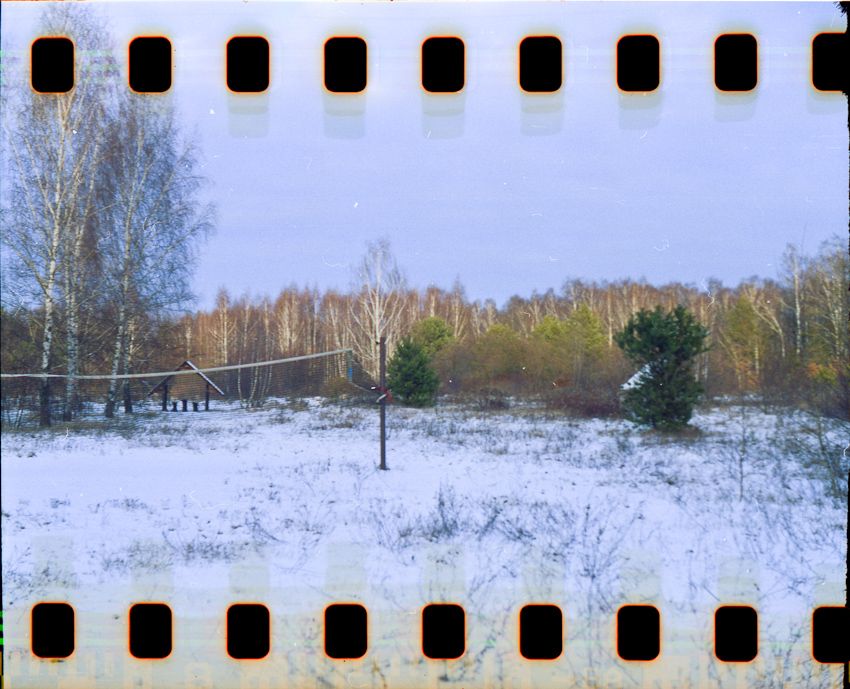
Well, I have finally developed film from the Yashica 44 loaded with 35mm film – Solution 200. As I wrote you this film is dedicated for the tests because of it price, however I saw in some galleries quite nice shots taken with that film.
Results are quite interesting, I must say that I like it however I’ve had some problems on the way. First problem was rewinding back the film. Because of the DIY modification described here there is no way of automatic rewinding the film. I had to do it manually. Problem was that it must be done in a complete darkness, as you have to do it with open back of the camera. It might be a problem to find a dark place during the day – I finally decided that the safest place will be sleeping room, under the quilt. That was the only real dark place at home. But I’ve managed to do it. There were no problem with developing as it normal C-41 process, however I found a problem during the scanning. Well there is a nice thing that you exposure the photo also on the perforation – because original film for this camera is 4×4 – however such film is difficult to scan. Epson V500 Photo has dedicated frames for scanning medium format, 35mm film without perforation (perforation is out of the scan area and it’s used to hold firmly strip of the film) and slides. No custom frame for that task. I had to use medium frame for that, and here was the heart of the matter – that frame didn’t hold the film correctly, the sides of the film normally are hold by the 35mm frame, and here it was free, that’s why the film was bending on the sides. You can see the ‘ghosts of the perforation’ – orange echo on the side of the film – that’s because the film wasn’t lying flat on the scanner glass. I’ve read that it’s possible to buy a special matt glass to avoid it – I will have to try it. Because of that situation sometimes I’m not sure whether film is not sharp because of the long exposure time or because of the scanning problems.
The last problem I found was with the advancing the film to the next shot. I didn’t expect (but I should), that the thickness of already exposed and winded film will have such influence on the distance or rather length of the film which moves during one knob turn. You have to remember that mechanism is designed for the film 4×4 (Type 127) with 12 shots. 35mm film is longer (36 normal exposures), and the frame is smaller. I’ve calculated earlier that I had to take two 180 degrees turns to advance to the next shot. I was able to take about 15 exposures with that setting. The result was that between first two shots distance between the frames on film is quite well calculated – less then 1cm, but for the last frames there was a lot of unused space between the frames – there was about 2,5 frame space left. So if I could see or compensate somehow the thickness of the film roll I could take many more photos. But it might be difficult. For the next film however I’ve calculated that I can from the 10th shot turn the knob only once. That will give me additional 5 photos on the same film… We’ll see.. but probably first I will look for that glass…
It took some time to expose the full roll, so the photos are from different places – some from Gdańsk, and some from Warsaw.
I forgot to write you advice to turn a blind eye to the focus and colours on those photos. Mostly because of above problems – and have in mind that that was first test roll.

Yashica 44, Solution 200, Park Kampinoski

Yashica 44, Solution 200, Park Kampinoski
It was too dark for the ISO200 film… and probably there were other factors to waste that shot… Metro Stare Bielany.

Yashica 44, Solution 200, Metro Stare Bielany
Two photos taken in Brzeźno, Gdańsk. It was really cold during that day. I forgot to write that I also have problems to calibrate the colours during scanning, so I had to postprocess those photos a little bit to make the colours more natural.

Yashica 44, Solution 200, Brzeźno

Yashica 44, Solution 200, Brzeźno
Last two photos were taken at the children playground in Warsaw, Bielany. I really like the photo of this horse, and this slide is also Very Special…

Yashica 44, Solution 200, Horse – children playground

Yashica 44, Solution 200, The Slide